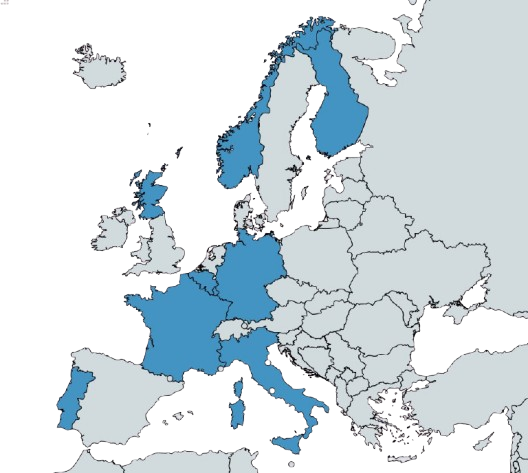
Founded in June 2025, the European Network for Bipolar (ENB) is a cross-border alliance of organisations led by, or working in close partnership with, people living with bipolar disorder. The network brings together associations from nine European countries with a shared aim: improving the quality of life, rights, and representation of people living with bipolar disorder and their families.
ENB supports cooperation across countries in research, advocacy, education, and policy development related to bipolar disorder. Through coordinated initiatives and engagement with public institutions, the network contributes to strengthening representation and improving mental health systems across Europe.
Its activities include collaborative research projects, training initiatives, public awareness actions, and participation in policy discussions. By connecting national organisations within a shared European framework, ENB promotes exchange of knowledge and practices, builds collective capacity, and supports consistent standards of participation and representation across countries.
Across Europe, support and representation for people living with bipolar disorder differ widely between countries. Some countries have strong organisations and structured services, while others have limited resources or no dedicated associations at all.
Organisations working in this field began to exchange experiences and identified similar challenges: limited coordination between countries, uneven inclusion of lived experience in research and policy, and few opportunities for organisations to collaborate at European level.
The European Network for Bipolar (ENB) was created to address this gap.
The network connects associations and partners in different countries and provides a common platform for cooperation. It supports shared advocacy, joint research initiatives, training activities, and dialogue with institutions.
By working together, member organisations can exchange knowledge, develop common projects, and contribute more effectively to mental health policy and service development.
The ENB strengthens the participation of people with lived experience in decision-making processes and promotes coordinated action across Europe in order to improve quality of life, rights, and access to appropriate support.

European Network for Bipolar (ENB) - President
Associazione Italiana Bipolari (AIBP) - Vice President

ADEB - President
European Network for Bipolar (ENB) - Vice President

Bipolar Scotland - Chief Executive
European Network for Bipolar (ENB) - Secretary

European Network for Bipolar (ENB) - Member & Research Delegate
... - FinFami

European Network for Bipolar (ENB) - Communication & Events Delegate
Bipolarité France - Founder & CEO

Bipolarforeningen Norge - Secretary General

DGBS - Member of Board

European Network for Bipolar (ENB) - Volunteer and Peer Support Delegate

FinFami - Development Coordinator

Bipolarforeningen Norge - User Representative

ADEB - Board Member
The European Network for Bipolar brings together organisations operating across different parts of the mental health ecosystem: peer support services, family organisations, research initiatives, clinical collaborations, advocacy groups, and public awareness programmes.
The network functions as a coordinated European structure in which each member contributes specific expertise and capacities. Community-based organisations contribute lived-experience knowledge and direct contact with service users. Research-oriented members contribute methodological expertise and data analysis. Other organisations engage with clinical services, family systems, or policy environments within their national contexts.
This distributed structure connects real-world experiences with systematic observation and practical implementation. Insights emerging from peer support and community activities can be identified across countries, discussed collectively, and translated into structured outputs such as reports, training activities, awareness initiatives, and collaborative projects.
ENB operates as a shared working platform that supports coordinated initiatives, development of transferable tools, and joint responses to common challenges in bipolar care across Europe. Through this model, the network strengthens cross-country collaboration while respecting the autonomy and specificity of each member organisation.
The European Network for Bipolar (ENB) works to strengthen mental health systems across Europe by integrating lived experience, scientific knowledge, and policy development into a coordinated framework for bipolar care.
The network promotes education, ethical standards, research collaboration, social inclusion, and public awareness. It supports the development of accessible and evidence-informed services while ensuring that people living with bipolar disorder and their families are meaningfully involved in shaping care pathways, research priorities, and public narratives.
ENB operates across local, regional, national, and European contexts. Its mission is to connect community-based knowledge with institutional dialogue, contributing to more responsive services, improved communication within care systems, and policies that reflect both empirical evidence and real-world experience.
The network is grounded in principles of inclusion, shared responsibility, transparency, and collaboration. It aims to strengthen trust between communities, professionals, and institutions and to foster sustainable improvements in bipolar care across Europe.
The European Network for Bipolar (ENB) presents the following operational framework as a structured model currently under development.
As a newly established network, ENB is in the process of building its collaborative activities across member organisations. The objectives and mechanisms described below outline the strategic direction the network intends to pursue, providing a transparent reference for future implementation, partnerships, and evaluation.
The European Network for Bipolar (ENB) is designed as a distributed European structure connecting member organisations with complementary expertise and operational capacities.
Rather than operating as a centralised organisation, the network aims to coordinate collaboration across countries by linking lived experience, community initiatives, professional practice, and institutional dialogue within a shared operational framework.
ENB aims to promote shared understanding of bipolar disorder across different contexts by supporting education, training, and the use of respectful and accurate mental health communication.
The network intends to encourage training initiatives for both professionals and volunteers and to promote clear, up-to-date language in public and service-related communication.
It also plans to develop practical guidance and ethical reference frameworks for support activities and interactions with services, helping reduce misunderstandings and improve accessibility of information.
ENB seeks to facilitate collaborative research and shared methodologies across countries in order to better understand needs, outcomes, and variations in bipolar care systems.
The network plans to coordinate participatory research activities involving member organisations and lived-experience communities.
Proposed activities include cross-national surveys, in-depth studies, and the development of standardised research tools, together with attention to ethical governance, responsible data sharing, and transparent dissemination.
ENB aims to improve public understanding of bipolar disorder and to promote the recognition of rights and dignity of people living with mental health conditions.
The network intends to support mental health literacy and coordinated awareness initiatives addressing stigma and discrimination.
It also encourages the meaningful involvement of people with lived experience in discussions concerning services, public narratives, and policy development.
ENB aims to strengthen cooperation among member organisations and support their long-term sustainability and development.
The network intends to create spaces for mutual exchange, peer learning, and organisational support between associations operating in different systems and contexts.
Current and upcoming areas of work:
Led by Bipolarité France, in collaboration with the European Network for Bipolar
Led by Associazione Italiana Bipolari (AIBP), qualitative research pilot within ENB
Led by Associazione Italiana Bipolari (AIBP), pilot within ENB for international scalability
We welcome collaboration with universities, institutions, health services, NGOs, and professionals who share our mission.
Collaborate with us to:
Clinical psychologist and full member of the Portuguese Order of Psychologists, recognised specialist in health psychology. His expertise includes psychological intervention in mood disorders, particularly bipolar disorder and depression, and the development of therapeutic and psychoeducational group interventions for individuals and caregivers.
He has worked at ADEB since 2008 and also practices in the private clinical sector.
Silje Gravaas Gåre is a lived-experience advocate and user representative with the Norwegian Bipolar Association (Bipolarforeningen Norge).
She contributes to public awareness initiatives, educational activities, and dialogue with healthcare services, sharing her personal experience of bipolar disorder to promote understanding and reduce stigma.
Her work focuses on strengthening the visibility of lived experience in mental-health communication and supporting earlier recognition and access to appropriate support for people affected by bipolar disorder.
Véronique Briquet-Laugier is a board member and lived-experience advocate with Bipolarité France.
She contributes to awareness campaigns, educational initiatives, and public dialogue on bipolar disorder, working to improve understanding, reduce stigma, and strengthen collaboration between people with lived experience, families, and healthcare professionals.
Salla Ristolainen is a Development Coordinator at FinFami – the Finnish Central Association of Families of People with Mental Illness.
She works on family-support programmes, education initiatives, and cooperation with healthcare services, focusing on improving information, support, and inclusion for relatives and caregivers of people experiencing mental health conditions, including bipolar disorder.
Her work contributes to strengthening the role of families within mental-health systems and to developing practical support pathways for carers.
This member doesn’t have a bio yet
Nina Antonov is the Secretary General of the Norwegian Bipolar Association (Bipolarforeningen Norge), a national user-led organisation representing people living with bipolar disorder and their families across Norway.
She has led the organisation since 2017, working on mental-health advocacy, stigma reduction, user involvement in healthcare services, and collaboration with clinical and research communities.
Under her leadership, the association has developed national peer-support services, including the Bipolarlinjen support line, and contributes to public awareness initiatives and policy dialogue on mental health.
Her work focuses on strengthening lived-experience participation in healthcare systems and improving early diagnosis and access to support for people with bipolar disorder.
Renaud Maigne is the Founder and Chief Executive Officer of Bipolarité France.
He holds a Bachelor’s degree in Maritime Business and Logistics from the University of Plymouth and has worked as a business consultant in logistics for IT projects. He is also the co-founder and CEO of the startup Eatwith, an international platform in the hospitality sector.
Renaud Maigne is the author of Un Monde Idéal Perdu (Eyrolles), a personal testimony describing his experience with bipolar disorder. Through both his professional and advocacy work, he contributes to raising awareness, promoting informed dialogue, and strengthening patient representation in mental health.
Jan-Eerik Leppänen doesn’t have a bio yet
Maja Mitchell-Grigorjeva is the Chief Executive of Bipolar Scotland, the national charity supporting people living with bipolar across Scotland. She has extensive experience in charity leadership, service design, and partnership working within the mental health sector, with a strong focus on peer-led and lived-experience-informed approaches.
Alongside her role at Bipolar Scotland, she serves as Secretary of the European Network for Bipolar, supporting international collaboration, knowledge-sharing, and advocacy. She regularly engages with policymakers, clinicians, and researchers to improve understanding of bipolar disorder, tackle stigma, and strengthen coordinated support.
Clinical psychologist and cognitive behavioural psychotherapist, full member of the Portuguese Order of Psychologists and recognised specialist in health psychology, community psychology, and psychotherapy. Her areas of expertise include psychological intervention in mood disorders, particularly bipolar disorder and depression, domestic violence and abusive relationships, psychotic illness, and the development of therapeutic and psychoeducational groups for individuals and caregivers.
She has worked at ADEB since 1999 and also practices in the private clinical sector.
Eleonora Caiazza is a research and project coordinator with international experience in mental health systems, ethics, and policy, developed across Italy and the United Kingdom.
She works on applied and patient-led research through AIBP and the European Network for Bipolar (ENB). In these roles, she coordinates projects integrating qualitative and quantitative analysis, ethical oversight, and the translation of findings into outputs relevant for institutions and stakeholders, with the aim of supporting systemic improvements in mental health policy and services.
She holds an MSc in Clinical Neurodevelopmental Sciences from King’s College London. Her work focuses on research ethics, data-informed policy development, and collaboration between patient organisations, clinicians, and public institutions at national and European levels.
Alongside the national monitoring initiative, AIBP is developing a qualitative research project focused on communication and therapeutic interaction in bipolar care. The study examines how communication between people living with bipolar disorder and professionals functions across different phases of the condition and how it influences collaboration, adherence to treatment, and continuity of care.
While clinical outcomes are often linked to medication and service organisation, everyday communication plays a central role in whether care remains sustainable over time. Individuals frequently report that understanding, trust, and the ability to participate in decisions depend not only on what interventions are provided, but on how information is explained, how uncertainty is managed, and how symptoms are interpreted during different mood states.
The project uses thematic qualitative analysis. A first phase has identified recurring themes and macro-themes emerging from patient narratives, highlighting patterns in communication during diagnosis, treatment adjustments, crisis situations, and follow-up. The next phase will involve in-depth interviews to further explore these mechanisms and understand how communication succeeds or fails in specific contexts and clinical phases.
Italy serves as the pilot setting for the research. The study is intended to evolve into an academically structured research programme and, within the European Network for Bipolar, to be progressively extended to other countries in order to compare experiences across different health systems and cultural contexts.
The long-term objective is to translate qualitative findings into practical and educational resources. Results may support university teaching activities, professional training initiatives, and seminars for mental health practitioners, providing both theoretical understanding and operational guidance on communication in bipolar care. The aim is to help professionals recognise how communication affects engagement, interpretation of symptoms, and therapeutic alliance throughout the course of the disorder.
By linking qualitative research, academic collaboration, and professional education, the project contributes to a broader effort to connect lived experience with clinical practice and to improve mutual understanding between patients and professionals.
The Associazione Italiana Bipolari (AIBP) is conducting a national research and monitoring initiative examining how mental health care is experienced in practice across different phases of treatment. The project combines a structured survey, qualitative analysis of narratives, and mapping of service pathways in order to observe patterns that may not be captured by administrative indicators alone.
Mental health systems are typically evaluated through measurable events such as appointments, admissions, and prescriptions. However, many factors that influence continuity of care occur within everyday interactions: communication, involvement in decision-making, clarity of information, accessibility of services, and consistency of follow-up. These elements rarely appear in official statistics yet strongly affect adherence to treatment, trust in services, and long-term stability.
The survey therefore functions as a large-scale screening and observational tool rather than a complaint mechanism. Participants report concrete experiences encountered during access to care, treatment adjustments, crisis management, and follow-up. Quantitative responses are analysed alongside anonymised narrative descriptions to identify recurring patterns across different settings and regions.
The project follows a bottom-up epidemiological approach. Instead of beginning with predefined clinical hypotheses, it starts from repeated experiences reported by service users and examines whether they converge into identifiable structural conditions. When similar patterns emerge across independent accounts, they can indicate systemic barriers, communication gaps, or organisational mechanisms that may affect outcomes and service utilisation.
To ensure methodological robustness, the initiative is being developed with academic collaboration and is designed to produce structured datasets suitable for research, discussion with clinicians, and institutional dialogue. The aim is not to evaluate individual professionals or services but to understand how care pathways function over time and where continuity becomes difficult to maintain.
Italy serves as the pilot context for the methodology. Within the European Network for Bipolar, the project is intended to evolve into a transferable monitoring framework that other countries may adapt to their own healthcare systems. By combining lived experience, structured data collection, and academic partnership, the initiative aims to create a bridge between community observation, scientific research, and policy development.
The long-term objective is to support evidence-informed improvement of mental health services, facilitate constructive dialogue with institutions, and contribute to policies that strengthen accessibility, communication, and continuity of care across Europe.
The Bipolar Pathway application is a free mobile mood-tracking tool developed by Bipolarité France and designed by and for people living with bipolar disorder. The project is being developed with the involvement of the European Network for Bipolar, whose member organisations are contributing feedback, testing, and future dissemination across countries.
Mood-tracking applications are increasingly used in mental health care because bipolar disorder is characterised by changes that unfold over time rather than isolated symptoms. Variations in mood, sleep, energy, and daily functioning often precede relapses or destabilisation, yet they can be difficult to observe during clinical appointments alone. Digital self-monitoring tools can help individuals recognise patterns, identify early warning signs, and support communication with healthcare professionals.
Currently, most available applications differ widely in quality, accessibility, and purpose. Many are commercial, require subscriptions, or are not specifically designed for bipolar disorder. Others collect personal data without clear governance or transparency. As a result, people often rely on fragmented or non-validated tools.
The Bipolar Pathway project seeks to address these gaps by providing a free, non-commercial, patient-created application focused specifically on bipolar disorder. The app allows users to record daily mood variations, sleep duration, emotional states, and medication intake, and generates visual summaries over time to support personal understanding and discussion with clinicians.
Data protection is a central aspect of the project. Personal data remain stored locally on the user’s device, and only anonymised information may be synchronised. Users retain control over whether to share information with healthcare professionals or relatives.
Version 1 of the application is intended as a proof-of-concept and will be followed by further developments, including more advanced monitoring tools and personalised support features. The European Network for Bipolar supports the project by facilitating international testing, collecting user feedback, and promoting accessibility across languages and countries.
The long-term objective is to make the application available as an accessible international resource, contributing to patient autonomy, improved clinical communication, and earlier recognition of changes in condition, while maintaining a non-commercial and patient-centred approach
Cross-country cooperation is expected to allow sharing of tools, adaptation of practices, and coordinated responses to shared challenges.
Through this collaborative structure, the network seeks to reinforce collective capacity and facilitate the circulation of knowledge and practical solutions.
How We Intend to Work
Support and Community Engagement
Community engagement is expected to focus on accessibility of services, social participation, and recognition of intersectional and minority perspectives.
Through collaboration with organisations and institutions, the network aims to contribute to more inclusive and responsive care environments.
How We Intend to Work
Advocacy and Awareness
By linking experiential knowledge with structured data collection, the network aims to contribute to evidence-informed dialogue with clinical, academic, and institutional partners.
Within this process, policy development is intended to emerge from collected findings, supporting discussions with institutions and encouraging the integration of mental health promotion into broader public health strategies across Europe.

How We Intend to Work
Research Collaboration
Policy Development
Capacity building is expected to develop through the exchange of practices among member organisations, collaborative educational activities, and accessible online resources.
The network also aims to encourage surveys, reports, and research initiatives to identify unmet needs and areas for service improvement, supporting more consistent approaches to education and service development across countries.
How We Intend to Work
Knowledge Sharing
Le Funambule asbl is a community-based organisation operating in Belgium and Luxembourg that supports people living with bipolar disorder and related mood conditions.
The association provides psychosocial support activities, peer exchange opportunities, and information sessions aimed at improving understanding of the condition and reducing stigma. Its initiatives encourage social inclusion and community participation, particularly for individuals who may experience social vulnerability.
Le Funambule also collaborates with mental health professionals and partner organisations in awareness and prevention activities.
FinFami is a Finnish national organisation supporting family members and close relatives of people with mental health conditions, including bipolar disorder.
The organisation promotes family involvement in mental health care and provides guidance, counselling, peer support groups, and educational programmes for relatives and caregivers. It also develops informational materials and training aimed at increasing understanding of mental health conditions and strengthening everyday coping.
In addition to support services, FinFami contributes to public discussion and policy development related to mental health, with particular attention to the role and needs of families and carers.
Bipolarforeningen is a national user organisation in Norway representing people living with bipolar disorder and their relatives.
The association focuses on peer support, self-help initiatives, and community-based activities aimed at reducing isolation and strengthening coping strategies. It provides local support groups, informational resources, and educational activities across the country.
Bipolarforeningen also works to raise awareness about bipolar disorder in society and engages with public authorities and health services to improve access to appropriate support and services for affected individuals and families.
The German Society for Bipolar Disorders (DGBS) is a national non-profit organisation dedicated to improving understanding, treatment, and support for people living with bipolar disorder in Germany.
The organisation brings together individuals with lived experience, family members, clinicians, and researchers. DGBS promotes collaboration between patient organisations and the medical and scientific community and contributes to the dissemination of evidence-based information on bipolar disorder.
Its activities include conferences, educational initiatives, public information resources, and cooperation with academic and clinical institutions. The organisation also supports participatory research and encourages dialogue between professionals and affected individuals in order to improve care and long-term outcomes.
Bipolarité France promotes a structured support pathway aimed at strengthening autonomy and self-management for individuals living with bipolar disorder.
A central component of its work is the development of digital tools designed to improve continuity of care and communication between patients and healthcare professionals. Through a dedicated application, individuals can monitor mood variations and relevant indicators, identify patterns and early warning signs, support treatment adherence, and access psychoeducational resources.
The platform also functions as a communication tool for caregivers and family members, facilitating a clearer understanding of the condition and its evolution over time. By enabling voluntary sharing of mood history and symptom-tracking data before or during consultations, Bipolarité France supports a more structured therapeutic dialogue between patients and psychiatrists and contributes to more informed clinical discussions between appointments.
The organisation’s work is grounded in the principles of patient empowerment, transparency, and collaborative care.
Key representatives
Renaud Maigne
Founder & CEO, Bipolarité France
Communication Delegate, European Network for Bipolar (ENB)
Renaud Maigne is the Founder and Chief Executive Officer of Bipolarité France.
He holds a Bachelor’s degree in Maritime Business and Logistics from the University of Plymouth and has worked as a business consultant in logistics for IT projects. He is also the co-founder and CEO of the startup Eatwith, an international platform in the hospitality sector.
Renaud Maigne is the author of Un Monde Idéal Perdu (Eyrolles), a personal testimony describing his experience with bipolar disorder. Through both his professional and advocacy work, he contributes to raising awareness, promoting informed dialogue, and strengthening patient representation in mental health.
Bipolar Scotland is the national charity supporting people living with bipolar across Scotland. Founded in 1992, it exists to ensure that no one faces bipolar alone.
At the heart of its work are peer-led services shaped by lived experience. Bipolar Scotland offers peer support groups, one-to-one peer support, self-management training, accessible resources, and meaningful volunteering opportunities. These services help people feel understood, reduce isolation, build confidence, and develop the skills and knowledge needed to manage their wellbeing.
Alongside direct support, Bipolar Scotland works to increase understanding of bipolar and to advocate for greater recognition, compassion, and coordinated support at a national level.
Key representative
Maja Mitchell-Grigorjeva
Chief Executive, Bipolar Scotland
Secretary, European Network for Bipolar (ENB)
Maja Mitchell-Grigorjeva is the Chief Executive of Bipolar Scotland, the national charity supporting people living with bipolar across Scotland. She has extensive experience in charity leadership, service design, and partnership working within the mental health sector, with a strong focus on peer-led and lived-experience-informed approaches.
Alongside her role at Bipolar Scotland, she serves as Secretary of the European Network for Bipolar, supporting international collaboration, knowledge-sharing, and advocacy. She regularly engages with policymakers, clinicians, and researchers to improve understanding of bipolar disorder, tackle stigma, and strengthen coordinated support.
ADEB (Association for Support of Depressive and Bipolar Patients) is a non-profit social solidarity private association headquartered in Lisbon, with offices in other parts of Portugal.
The organisation maintains partnerships with public and private national and international entities and focuses its activities on supporting people with depression or bipolar diagnoses and their associated comorbidities, as well as their families. Its members include individuals with lived experience as well as medical doctors, psychologists, nurses, social workers, and other mental health professionals.
As of December 2024, ADEB had nearly 5,000 members nationwide, making it one of Portugal’s largest mental health associations and the only one specifically dedicated to people with unipolar depression and bipolar disorder and their families.
Its main goals include providing integrated mental health care, offering specialised education and training, supporting unemployed members, and developing a Social-Occupational Forum. ADEB also promotes psychosocial rehabilitation through psychoeducation and psychotherapy programmes delivered both individually and in groups.
The organisation is actively involved in identifying scientific research priorities based on real-world needs and carries out awareness, advocacy, and self-help initiatives alongside several other services.
Key representatives
Renata Frazão
President, ADEB
Vice President, European Network for Bipolar (ENB)
Clinical psychologist and cognitive behavioural psychotherapist, full member of the Portuguese Order of Psychologists and recognised specialist in health psychology, community psychology, and psychotherapy. Her areas of expertise include psychological intervention in mood disorders, particularly bipolar disorder and depression, domestic violence and abusive relationships, psychotic illness, and the development of therapeutic and psychoeducational groups for individuals and caregivers.
She has worked at ADEB since 1999 and also practices in the private clinical sector.
Sérgio Paixão
Board Member, ADEB
Clinical psychologist and full member of the Portuguese Order of Psychologists, recognised specialist in health psychology. His expertise includes psychological intervention in mood disorders, particularly bipolar disorder and depression, and the development of therapeutic and psychoeducational group interventions for individuals and caregivers.
He has worked at ADEB since 2008 and also practices in the private clinical sector.
The Associazione Italiana Bipolari (AIBP) is a national non-profit organisation in Italy dedicated to supporting people living with bipolar disorder and their families.
AIBP combines peer support activities with advocacy, research initiatives, and collaboration with mental health services. The association provides support groups, educational programmes, and informational resources aimed at improving understanding of bipolar disorder and facilitating everyday management of the condition.
In addition to community support, AIBP conducts user-led surveys and reports on patient experiences in mental health care. The organisation works with clinicians, researchers, and institutions to promote patient involvement, improve communication within services, and contribute to the development of more accessible and coordinated care pathways.
Through its activities, AIBP promotes participation, informed dialogue, and the inclusion of lived experience in mental health policy and practice.
Key representatives – Eleonora Caiazza
President, European Network for Bipolar (ENB)
Vice President, Associazione Italiana Bipolari (AIBP)
Eleonora Caiazza is a research and project coordinator with international experience in mental health systems, ethics, and policy, developed across Italy and the United Kingdom.
She works on applied and patient-led research through AIBP and the European Network for Bipolar (ENB). In these roles, she coordinates projects integrating qualitative and quantitative analysis, ethical oversight, and the translation of findings into outputs relevant for institutions and stakeholders, with the aim of supporting systemic improvements in mental health policy and services.
She holds an MSc in Clinical Neurodevelopmental Sciences from King’s College London. Her work focuses on research ethics, data-informed policy development, and collaboration between patient organisations, clinicians, and public institutions at national and European levels.